

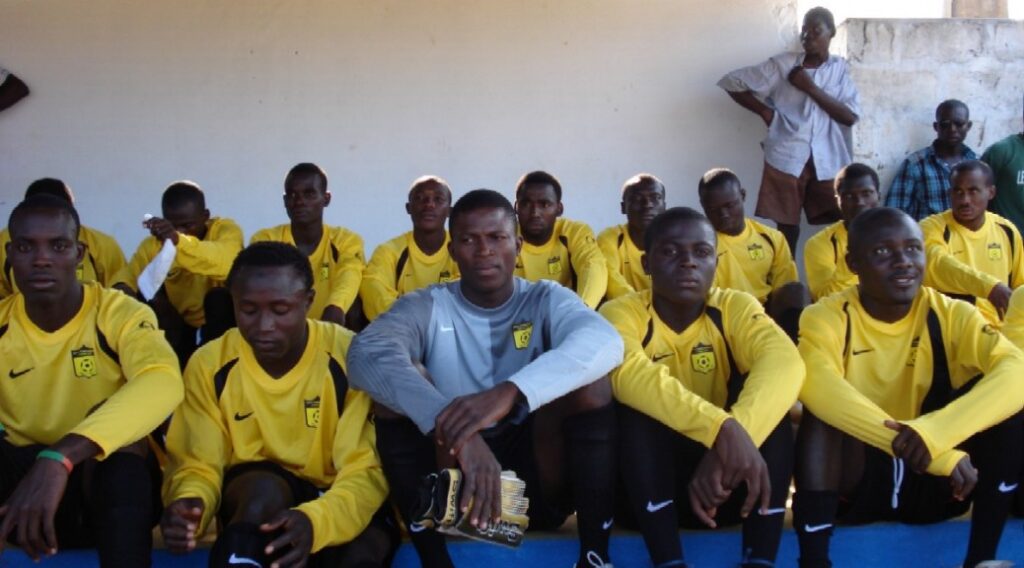
Division 2 Ghanaian club Keta Sandlanders, based on the coast of Ghana’s Volta Region, is one of the more interesting clubs around, not necessarily because it has trophies busting through the clasp of some varnished trophy cabinet, or because the Sandlanders have produced Ghanaian talents that are now household names, but because of the club’s vision of what the Sandlanders could be.
Over the years, countless academies and clubs have set up shop across the African continent with the express purpose of developing young players, or so they say. Some have been successful, while others are purely parasitic. But even in the midst of the successes, it’s hard to ignore the rampant shadiness that hovers like a dark cloud over parts of African football.
At times, it’s hard to turn your head away from the legacy of resource mining in Africa. Taking a look back, there’s an eerie parallel between the mineral mining that took place in Africa during colonialism (and still continues), and mining the continent for young football talent. Both practices exist, not necessarily because of some charitable desire, but rather because of a basic recognition that Africa is resource rich, and it’s resources are readily exploitable at low costs. Cynical, perhaps. But there’s a track record to support some cynicism. In 2008, the Guardian’s Dan McDougall reported the following:
There are an estimated 500 illegal football academies operating in Accra alone. Thousands more are spread across Ghana. Many are run by the roadside; most have no proper training facilities. With biblical names such as ‘Sons of Moses’ and ‘Lovers of Christ’, each will have its own tatty bibs or T-shirts to distinguish it from the others. At the children’s side, egging them on to run, pass, think quicker, will be a legion of unlicensed agents and coaches. Ninety per cent of the academies we visited in Accra and Abidjan – the principal city of Ivory Coast – were run by local men with limited experience of the game. Most described themselves as former footballers; but none was able to produce proof of his career. They are intent on finding one thing only: the next Essien or Didier Drogba. The next multi-million-pound golden ticket.
McDougall’s article highlights rampant abuse by a diverse cast of characters. The culprits are foreign and African, rich and wannabe-rich, individuals and corporations, but all are tied together by one common goal: to uncover diamonds for monetary gain under the guise of helping the youth. But all mining isn’t bad per se. It just comes with some responsibility, or at least it should.
Miners extract valuable resources from communities. Therefore, there’s a responsibility to give back to the community from which resources are being extracted, especially when the extraction is really just for monetary gain. However, responsibility has been an afterthought. So what remains is a mining culture cloaked by sophisticated PR campaigns, duping passers-by into believing that everyone has the heart of Mother Teresa.
African youth academies and clubs are easily manipulated for personal gain and image development. Nothing creates a more compassionate public profile than helping out poor African kids, right? Have you ever asked yourself why everyone wants to put their hand into soccer academies in Africa? Why not science academies or other academic academies that are likely to have a greater impact than soccer? I’m not questioning the value of soccer academies, but the prevalence of academies does raise questions about why they exist and what they are doing. In many ways, the African youth academies have become the football equivalent to African babies for celebrities. Be rich, help Africans, take resources, and send out a press release about how compassionate you are. It’s brilliant stuff, really. But what is really being done?
It is in this rough and tumble world of academy and club football that Keta Sandlanders stands out as an example of what could be. Exporting young talent and winning major trophies are not high on the Sandlanders’ immediate list of priorities given that the club has only been in action for a few years. Sure, like any club, the Sandlanders are fighting for promotion. But the club’s greater focus is properly on creating a responsible, sustainable model based on a member-owned structure, community-oriented growth, technology, and a strategy to lead community development projects in Keta.
The Sandlanders have built community and development into their model. The club will increasingly use its website to promote local industries in Keta and to give visitors a taste of daily life. The area has a beautiful coast line and strong tourist potential. Keta occupies a sand spit between a lagoon and the sea (hence the Sandlanders name) and has suffered greatly through the impact of erosion, but a coastal defense scheme completed a few years ago has made the area viable for development once again. The club has long term plans to develop these types of community projects. In fact, one-fifth of the money raised is contributed to sustainable community development programs in Keta. These aren’t side projects, but integral components of the club’s DNA. That’s not just admirable; it’s also responsible.

It is helpful to juxtapose Sandlanders with the Red Bull Soccer Academy as a comparison point. No, not the one in New York, but the Red Bull Academy in Ghana’s Volta Region. The mission of the Red Bull Academy, according to Hermann Kern, the Academy’s General Manager, is to provide “its products with all the academic requirements, so that they can express and make intelligent decisions as they strive to reach the top in both their soccer and academic pursuits.” Members of the community around the Academy are allowed to use the Academy’s IT facilities, and Red Bull has provided a decent drinking water facility, which probably makes more sense than providing a Red Bull energy drink facility.
As wonderful as Red Bull’s initiative is, it simply serves to highlight why the Sandlanders approach is so admirable. Although providing a service for the community is all well and good, we shouldn’t conflate a development academy’s side projects with the desire to really invest in community transformation. Being a neighbor is a nice gesture, but it isn’t always enough.
But is it a club’s responsibility, especially one headed by major foreign investors, to develop communities? In my opinion, yes. Over the past few decades, I’ve seen too many examples of wealthy investors moving into neighborhoods thinking that their presence is good enough. But every new footprint in these communities comes at a cost. If clubs think responsibly and truly want to make a long-term difference, clubs can be uniquely placed to lead development projects.
Even though the Sandlanders are not yet on the level of major African clubs such as Ghana’s Hearts of Oak and Egypt’s Al Ahly, clubs around the world could learn a thing or two from the Sandlanders. In an era marred by financial mismanagement and quick-fixes, the Sandlanders approach can go a long way to proving that success doesn’t necessarily have to come from corporate greed or resource manipulation. There are other models to explore how success and responsibility can co-exist.
We caught up with the Sandlanders team, specifically Sandlanders Chairman and Founder Frank Cole and Vice-Chairman Paul Jones, to talk, well, Sandlanders, of course. Tomorrow, we’ll share a few highlights from our exchange.